 |
| Mike "MT" Terry |
Dave Grohl just released Sound City, a fantastic film documenting the history of the famed Los Angeles recording studio and its incredible Neve console (which Dave Grohl purchased when Sound City Studios closed in 2011). Mike Terry (Eagles, Foo Fighters, Jessica Simpson), who helped design Lauten Audio's Horizon, Oceanus, Clarion and Torch microphones, worked his way from the ground up at Sound City early in his career. So we decided to ask him some questions about his time there and the impact it has had on the rest of his career.
When did you work at Sound City?
I started in February 1998 as a runner, and then began assisting in the spring of that same year. I left near the end of 2002.
How did you get the gig?
I was a runner at the
Village Studios for nearly a year. One of the Village assistant engineers had a two-day engineering gig at Sound City in Studio A. He knew that I wanted to move up and was ready, but there wasn't room for me at the Village; he told me how great Sound City was and that it was right up my alley.
I called Sound City to ask around, and, of course they didn't have an opening right then, but to send a resume. I did and then kind of forgot about it. I picked up a short internship at
Grand Master Studios and did a bit of moon lighting there while I continued working at the Village. A couple months later Shivaun, the manager at Sound City, called me in for an interview. It went well, she offered me the job and I accepted.
How many hours a week did you work; we hear runners and assistants rarely slept. Is this true?
(
laughs) Quite a few hours indeed. I became a full time assistant engineer within a few months after starting and the hours really kicked in then. There was one particularly good week, thanks to a producer by the name of
Matt Hyde. I logged 119 hours. Typically it was only 80-90 hours per week - not too bad. Most sessions would start between 10am and noon. I'd get there about an hour early to prepare and get tube gear warmed up. Sessions were only supposed to go 12 hours, but many pushed well beyond that. Shivaun was usually a softy when it came to charging overtime so it became the norm and was easy for clients to get away with it.
My rule of thumb was, if I didn’t leave for home by 5:15 in the morning, I would sleep on the couch in the studio. The morning rush hour was so bad after 5:15 that it would take too long to get home - I learned my lesson when I fell asleep sitting in traffic one morning. Fortunately, we were at a standstill, my foot slid off the brake and I woke just before bumping the car in front of me.
Matt Hyde’s projects were often on a tight schedule so we put in a lot of hours together and drank a lot of coffee. One night... actually morning around 5am we were calling it a day and he said, "alright" looking down at his watch "I think we should be back by 10, nah better do 9am." At that point, I decided to just sleep on the couch in the studio. Then he looked up and said "I guess that doesn't give us much time to sleep, wanna just go play golf?"
 |
| Mike in Sound City's Studio A circa 1999 |
Do you remember the strangest errand either you or someone else had to run?
When
Krispy Kreme Donuts came to LA, everyone went berserk for them. One opened not too far from the studio. We sent a runner to get a dozen hot glazed donuts on opening day. He came back over two hours later. Everyone was giving him a hard time for taking so long. It turned out that there was a line all the way down the road and around the block forcing him to wait the whole time. Apparently there was even a band set up out front to keep everyone entertained. To say the least, the donuts were gone within moments of his return, meaning only one thing. (
chuckles) Go for one more dozen please. Wait, better make it two!
Assistants’ duties these days are much different from back then, but are there things that you learned to do at Sound City that you ask your assistants to do today?
I think more than anything, I want them to stick around, stay quiet and be alert to what is happening in the session. If I have to go looking for the assistant to help move some mics, or change a patch, whatever, I’m going to do it myself. If that continues, then it’s time for a new assistant. Aside from that, it’s nice to keep the place tidy with mic cables organized and easy to reach. Leaving pencils, Sharpies and console tape in all of the places where they can be used is also good practice. Documentation is expected - don’t wait to be asked to do it. If someone has to ask, it’s probably too late.
 |
| The Neve in Studio A at Sound City Studios circa 1999 |
What do you think separated you from the others assistants?
A few months after I came to Sound City,
Sylvia Massy decided to install Flying Faders on her Neve 8038 that was in Studio B. I knew how to operate them, I knew how the console worked, and I figured out where everything was on the patch bay. The other runners didn't know any of that. So when an assisting slot came up for grabs, it went to me. After that it was a matter of building trust with the clients and building the relationships that helped move me up.
When I was assisting, I always felt that I should try to work in as many rooms as possible, and whenever an opportunity would come up to fill in someplace new, I would jump on it. By the time I started first engineering, I was really comfortable working in many different rooms and with a variety of consoles, gear, and mics. I learned not to rely on any one specific room or particular piece of gear, though I certainly did find my favorites.
Once you moved up at Sound city, was there any advice you gave to the runner that came in behind you?
Always work the night shift. That way you could have a chance to get into a session. After dinner, most sessions go into a little bit of a slow-down and those on the inside are more willing to let those on the outside come in for a bit.
 |
| Recording Drums in Studio A's live room at Sound City circa 1999 |
Who did you work for there that made the biggest impact on you and in what way?
Frank Black and the
Catholics would cut live to two-track records there. I assisted on the album "Dog in the Sand." To see these guys lay down a record completely live was incredible. After getting used to the overdub process that takes weeks on end, this raw approach was both refreshing and inspiring. Charles (Frank Black) would come in every day during the sessions with a new song that he wrote the night before after leaving the studio, and we would record it. That's serious dedication to the craft, listening to the muse when it speaks and doing the work that needs to be done when it’s called for. That type of thing made a big impression on me.
Some of these guys, the great ones anyway, work really hard at what they do. Often times the majority of their work is done in their own private environments. The work that is done in the studio is really just the tip of the ice berg.
I've always been impressed with the prolific as it's usually a sign of dedicated and unrelenting work mixed with incredible talent. Dave Grohl is one of them. Not only is he a cool genuine dude, he's really good at playing instruments, writing songs, telling stories - he's even a pretty decent ping pong player. He may say different, but I know for a fact that he puts in the time and works incredibly hard at what he does. Seeing these guys work so hard was really encouraging and I tried to do the same on my end.
 |
| Mike commanding Sound City's Neve and tape machine |
Can you tell us which producers and/or engineers in your early years taught you the most?
There are several. Studio A was and has always been known as a great drum room. The majority of work done there at the time was drum recording. Then the project would leave for another studio to do their overdubs. Studio A was always booked, making it hard to get more than two weeks at a time. Because of that, I had the opportunity to be on sessions with so many great drummers and engineers that knew how to record them. Studio A for me was basically boot camp for drum recording. We recorded drums in just about every type of configuration imaginable.
I worked on several records with Matt Hyde. He came in mostly to get his drum tracks, two to three weeks at a time. One summer, maybe 1999, he had Studio A booked out for three months. I think we did two or three records during that stretch. It was with Matt that I learned and understood drum recording. He was willing to experiment as much as possible, try new mics and micing positions, that sort of thing.
Matt was really keyed into the importance of drum tuning and would always have Gersh from
Drum Fetish keep them in tune. Gersh would tweak the snares and toms between takes, and do whatever was needed to keep the drums sounding consistent from one take to the next. Both Matt and Gersh were super cool about showing me what they were doing and how to do it. Often times a quarter turn on the lug of the snare, where the stick crosses the rim, does the trick.
Joe Barresi was also a regular. My god, that guy is the one who sets the bar for engineering in my book. Gain structure and getting the phase correct are the bare essentials I learned from Joe.
Start by getting the kick, snare and overheads in phase, use the phase button and move the mics around until they all sit properly. Then, add in the rest of the mics one at a time, checking the phase against the kick, snare and overheads; if it doesn't fit, then go move the mic until it does fit.
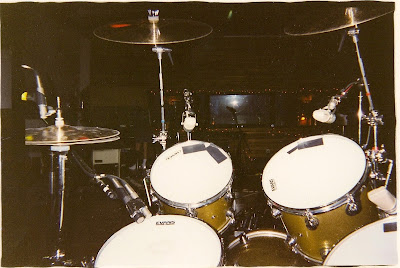 |
| View from behind the drumset in Studio A at Sound City circa 1999 |
Same principle applies to micing guitar amps. Start with one mic (I use a
Horizon to start), then add in others, checking the phase against the first. EQ for shape and flavor if you feel like it; otherwise, leave it alone. Drive it into a compressor if you feel the need, but remember to keep checking the phase to make sure everything is still sitting well.
Around 2001 Ross Robinson and
Mike Fraser (Fraze) started coming in - first to record a band called Amen and then we did a Slipknot record. Nothing could have prepared me for the first session, I mean nothing! Ross produced Amen's first record a couple years prior. For their second record, they were looking to get an AC/DC type of drum sound.
Fraze did a lot of work with AC/DC and was the natural choice as engineer. Fraze and I showed up on the first day to get set up. We had never met before but hit it off immediately. We did a beautiful job with the drum setup in Studio A. When Ross came in a little later with the band, they were really confused as to why we would set the drums up in the big room. Ross began explaining that he needed everyone in the same room, all right up on top of each other in this big open room. He also added that we better tape the mics down or do whatever we needed to keep them in place, because Casey, the singer, would be jumping all over the drums during recording. Later that night, I found everything Ross said to be absolutely true.
By dinner time we had the drums setup in a 12 foot by 12 foot back room with 8 foot ceilings. It was basically an old office that we would typically use for guitar amps, allowing us to keep them isolated from the big drum room.
We had a reel of GP 9 loaded on the Studer 800. Ross was in the small room with the band and said to roll. We didn't know that he was going to be in the room during the recording. My experience up to that point was that the producer is always in the control room with us. We pressed record, and let the tape roll. They did three takes back to back; we never stopped the tape. Through the mics we could hear them putting their instruments down and leaving the room. Thirty seconds later Ross ran into the control room screaming for a razor blade. I pointed to the top of the Studer 800 and before I was up from my chair, he was at the tape machine rewinding to the middle of the reel - my guess was somewhere in the second take. He hit play, grabbed a grease pencil, dropped the gate and marked the tape as it passed by. Hitting fast forward, he went towards the end of the reel, played it again, and made another mark. I swear, without even double checking his marks, he had the tape on the cutting block with the razor blade slicing through, then manically pulled from the supply side until he found his first mark, another cut without listening, then he taped the two ends together.
He ultimately spliced the end of the third take to the end of the second take. He rewound and played from the beginning of the song and through the edit to the end. Not only was it a perfect edit but it also became the master take.
I learned to edit tape working with those two guys. The three of us worked together for the next few years. When Sound City wasn't available for one of the projects, Ross found a studio on the boardwalk in Venice Beach. I took a leave from Sound City to do that one. Both Ross and I lived in Venice and it was pretty great to have a studio right there. Fraze lived in Vancouver so he would stay in a hotel in the same area. After a while, we didn't want to go anywhere else, so I had to leave Sound City for good.
 |
| The Neve in Studio A at Sound City Studios circa 1999 |
Was there something besides the room and board that made Sound City such a mecca for recording great albums?
The Neve in Studio A and the tracking room was the real draw. Studio B became quite popular while I was there also because both rooms were regularly booked. There were the regulars, some of whom I mentioned earlier, who became quite comfortable there. I think it was a place that didn't look like much aesthetically speaking as it was pretty worn out, but once you did a project there, it became clear. It sounded good, it was affordable, the staff was nice, and if you were in the know, the Friday afternoon BBQs became quite popular too!
Interviewed on 2/14/2013 by Ben Lindell and Brian Loudenslager. Photos courtesy of Mike Terry.
For more information about Lauten Audio visit
http://www.lautenaudio.com
For more information about Mike Terry visit
http://www.miketerrysound.com

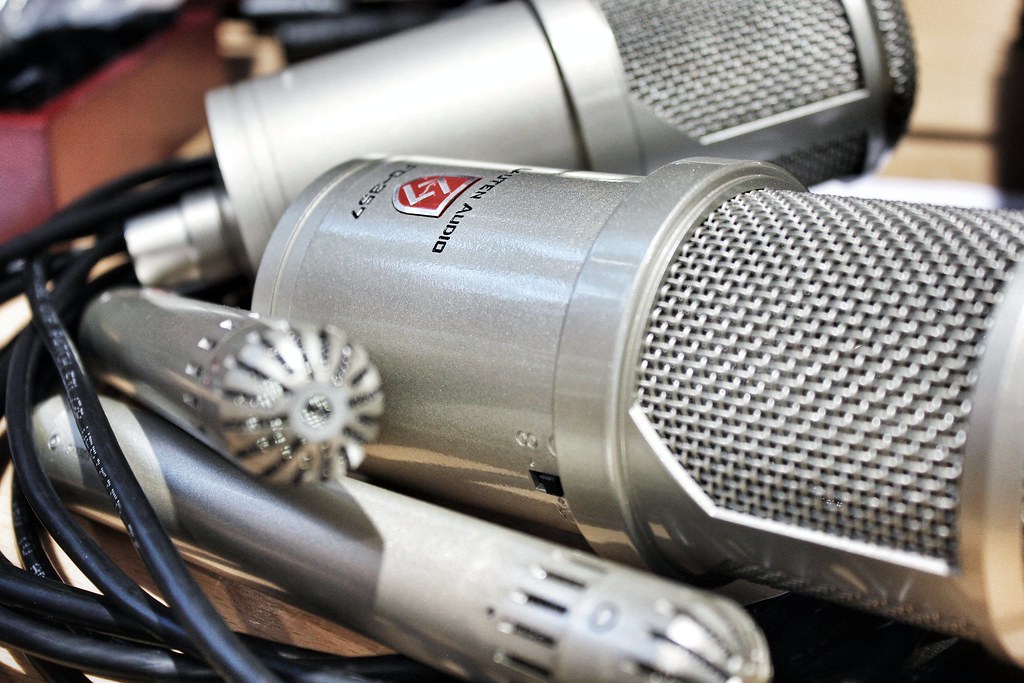 The RME Sessions rewards one lucky unsigned band with a day of studio time at AIR Studios in London along with producer Tony Newton to record a song. This past November, Nick and the Sun Machine came to the studio and recorded their song "Mountain".
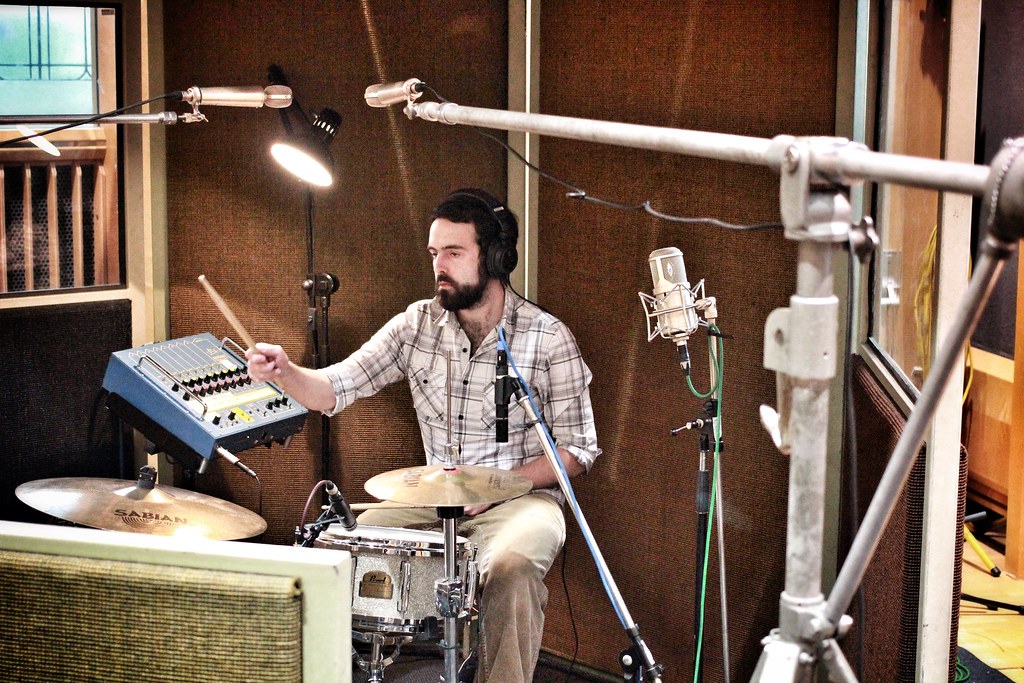 On Lead Vocals was a Lauten Atlantis FC-387, after auditioning the different voicing options they settled on the Neutral setting.


